Borobudur is stone poetry you can walk through. For me, the best parts are the carved Buddha reliefs you can study up close, and the way the temple frames the Menoreh Mountains when the light hits the stone. This kind of ticket visit is also a bit of a time-management game, and you should think ahead if you want every level.
You get entry to one of the world’s biggest Buddhist monuments, set on a hilltop above green fields. The temple covers about 2,500 square meters and is decorated with 2,672 relief panels, with an original plan that included 504 Buddha statues. One drawback to keep in mind: the ticket you pre-book covers the main entry, but the climb to the top requires an additional ticket.
In This Review
- Key things to know before you go
- Why this Borobudur entry ticket is a smart use of a Java day
- Using your digital entry ticket at the entrance kiosk
- Green Park to start: a relaxed warm-up walk
- The Borobudur layout: how to move through 2,672 relief panels
- Buddha statues and stone legends: what to look for on the walk
- Sailendra vs. Gupta influence: the architecture lesson you’ll feel without a lecture
- Views from the hilltop: where the Menoreh Mountains show up best
- The top of Borobudur: consider the extra climb ticket
- Timing and hours: how to avoid a rushed Borobudur visit
- What to bring and what rules to expect
- Who this Borobudur ticket visit fits best
- Should you book this Borobudur entry ticket?
- FAQ
- What is included with the Borobudur entry ticket?
- Where do I redeem the digital ticket?
- What are the Borobudur Temple opening hours?
- Do I need an extra ticket to climb to the top?
- How long is the ticket valid?
- Who needs to buy a ticket based on age?
- What should I bring with me?
Key things to know before you go
- Digital entry ticket, redeemed at a kiosk near Borobudur’s entrance
- Green Park entry walk with regulated vendors so it does not take over your visit
- 2,672 relief panels arranged across the temple walkways and terraces
- Sailendra-era temple (AD 780–840) with Indian Gupta architectural influence
- Top-climb access needs an extra ticket if you want the full experience
Why this Borobudur entry ticket is a smart use of a Java day
Borobudur is the kind of place where you stop thinking like a tourist and start thinking like a reader. The temple is designed as a full route through story, symbols, and Buddhist ideas—then you’re left standing in front of the stonework like it’s still talking.
I like that this ticket gives you access without forcing a heavy guided schedule. You can pace yourself through the relief panels and carvings, pause for views, and focus on the details that click for you. And because the site is huge (about 2,500 square meters), having your entry handled in advance means you’re less likely to lose precious morning hours.
The value piece is simple: you’re paying a small entry amount for a globally famous monument, while keeping flexibility on how much you want to do beyond main access. In other words, you can treat it like a highlights visit, or like a slow, respectful “read the walls” day.
You can also read our reviews of more tours and experiences in Borobudur.

Using your digital entry ticket at the entrance kiosk
This is a pre-booked entry. You get a digital ticket that you redeem directly at a kiosk near Borobudur’s entrance. That matters because your time and energy are better spent on the temple than sorting paperwork at the last second.
A couple practical notes before you show up:
- Bring your passport or ID card. The requirement is explicit.
- Gates close 30 minutes earlier than operating hours. So if you roll in late, you’ll feel it fast.
- This activity is non-refundable, so double-check your plans before you lock it in.
The host or greeter is listed as English and Indonesian. That’s useful if you have quick questions on-site, especially when you’re trying to figure out where to go next.
Green Park to start: a relaxed warm-up walk
After you enter, you can walk through Green Park from the entrance. This is not just a random approach path. It’s your first taste of the site’s flow, before you get into the main temple structure and its terraces.
You may also see vendors along the way. The key thing is that there are regulations meant to prevent vendors from disturbing visitors. Translation: you can browse if you want, but you should also feel free to keep moving if you’re there for the carvings.
I like this setup because it helps you transition from the outside world into a slower rhythm. You’re not immediately hit with the biggest climb or the tallest viewpoints. You ease in—then the temple itself takes over.
The Borobudur layout: how to move through 2,672 relief panels
Borobudur’s scale is the first thing that surprises people. The temple’s decorated surface is about 2,500 square meters, and the relief program totals 2,672 panels. That is a lot of stone storytelling, which means you need a plan for your eyes.
A helpful way to think about it: Borobudur isn’t one flat monument. It’s built as a series of levels and pathways. As you walk, you’ll see how scenes connect into larger ideas—legends, teachings, and moral messages. The stonework isn’t decorative filler. It’s designed to be read as you move.
Also, pay attention to carvings attached to the temple itself. The reliefs and legends are there for you to spot, not just “look at from far away.” If you rush, you’ll see the monument and miss the message. If you slow down, you’ll start noticing patterns—symbols that repeat, figures in different scenes, and the way certain stories develop across panels.
Buddha statues and stone legends: what to look for on the walk
Here’s the core of what makes Borobudur so compelling: the carvings and figures are tied to Buddhist philosophy, not just local decoration. The temple includes carvings that display legends and stories with philosophical meaning, and the site originally featured 504 Buddha statues as part of its original design vision.
What you should do as you move:
- Stop long enough to read the scene focus. Don’t just photograph.
- Look for how the story relates to what you’ve already passed. That’s where Borobudur becomes more than a “big temple.”
- Keep an eye on the stone details attached to the structure. That’s where the narrative tends to be clearest.
If you want a more meaningful visit, you’ll do better with a simple mindset: you’re not trying to see everything perfectly. You’re trying to catch the main ideas and a handful of scenes in good detail. That approach fits the reality of how crowded and time-sensitive the day can be.


Sailendra vs. Gupta influence: the architecture lesson you’ll feel without a lecture
Borobudur was built between AD 780 and 840 during the Sailendra dynasty. One of the coolest parts of visiting is realizing how connected this region has been to wider art and religious traditions.
The temple’s design is described as having Gupta architecture influence, which reflects India’s impact on the region. But Borobudur is not a copy. You can also find indigenous scenes and elements built into the overall look, which makes the monument distinctly Indonesian rather than “imported” in a bland way.
Why you’ll care as a visitor: when you understand that it’s a blend, you start noticing differences in the artwork and the story elements. You stop viewing it as one uniform style. You start seeing it as a creative meeting point—local identity combined with imported architectural ideas.
Views from the hilltop: where the Menoreh Mountains show up best
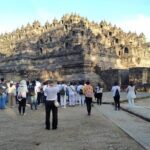
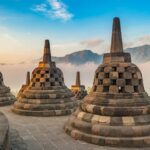
Borobudur sits majestically on a hilltop overlooking lush green fields and distant hills. The temple is designed so the setting matters. When the weather cooperates, the Menoreh Mountains backdrop turns the stone monument into something bigger than itself.
Practical tip: plan for at least one pause where you don’t move. Walk, stop, breathe. You’ll get more out of the carvings when you’ve had a moment away from the details.
This matters because Borobudur can feel like information overload if you never reset your attention. A short “view break” helps you return to the reliefs with clearer eyes, and you’ll start noticing how the temple’s lines and angles hold up even against the wide horizon.
The top of Borobudur: consider the extra climb ticket
One major decision point is whether you want to climb to the top. The information here is clear: an additional ticket is required to climb to the top, and it’s not included with the basic entry ticket.
From a value standpoint, this choice is about payoff vs. time. Top access often means more steps, more crowd flow at bottlenecks, and less time to linger on lower-level relief panels. If you’re the kind of visitor who wants the full “vertical story,” the extra climb ticket can be worth it.
At the same time, if your priority is carvings and philosophical storytelling up close, you might prefer to spend your energy on the reliefs where you can get closer and take your time. Either way, decide before you get trapped in the middle of the route.
Timing and hours: how to avoid a rushed Borobudur visit
Borobudur’s operating hours are listed as 06.30 to 16.30 WIB. Gates close 30 minutes earlier than operational hours, so plan to be inside before that last buffer.
I recommend thinking in two phases:
- A first phase for reliefs and main temple walkthroughs.
- A second phase, only if you have the extra ticket or energy, for top access.
The biggest mistake is trying to do every option plus long pauses without thinking about the clock. This place rewards attention, but it also runs on time windows and flow of entry. If you show up near gate-closing time, you’ll almost certainly feel the pressure.
What to bring and what rules to expect
Keep your visit comfortable. The required items are straightforward:
- Passport or ID card
- Comfortable shoes
- Comfortable clothes
- Face mask or protective covering
You’ll thank yourself for comfortable shoes fast. Stone surfaces and level changes add up. Comfortable clothing is also key, especially when you need to move steadily through the temple levels.
On-site, you should also expect that parts of the area are managed to keep the visitor experience focused. Vendors exist, but regulations are meant to prevent them from disturbing visitors, so you can treat Green Park as a normal warm-up rather than a shopping zone.
Wheelchair accessibility is listed. If mobility is an issue for you, it’s worth planning carefully with the site route in mind, since a temple layout still means lots of movement choices.
Who this Borobudur ticket visit fits best
This entry ticket is a great fit if you want a self-paced, value-focused way to experience Borobudur. You’ll enjoy it most if you like:
- Architecture and religious art you can inspect step-by-step
- Relief storytelling that rewards slowing down
- Big viewpoints tied directly to the temple’s setting
It may not be ideal if you want a full-day guided program with deep explanation and translation at every turn, because the info structure here is built around entry access plus on-site help (English/Indonesian). If you’re visiting with limited time, you’ll also want to be decisive about whether you’ll buy the extra top-climb ticket.
If your goal is simply to see Borobudur as a whole monument from key points, this is still a solid way to go—just plan your route so you don’t end up sprinting between levels.
Should you book this Borobudur entry ticket?
Yes, book it if you want reliable access to Borobudur at a low price and you’re happy to build your own rhythm through the relief panels and carved details. Pre-booking and using the entry kiosk is a practical move, especially when you’re visiting from Yogyakarta and you’d rather spend time on the stones than handling last-minute logistics.
I’d think twice if you’re the type who needs every detail explained and translated, because the visit here is structured around access rather than a long, fully guided lecture. Also, before you commit, double-check that your ticket is valid for your visitor category and will redeem smoothly at the kiosk. Tiny eligibility mistakes can waste time right at the start.
If you do book, plan for the extra top climb ticket only if it matches your priorities. If your priority is the carvings and philosophy on the route, you can still have a powerful visit without trying to force every possible access level into one day.
FAQ
What is included with the Borobudur entry ticket?
The information provided says inclusions may vary by options. What is clearly not included is hotel pickup and drop-off, and the additional ticket required to climb to the top.
Where do I redeem the digital ticket?
You redeem the digital entry ticket at a kiosk near Borobudur’s entrance.
What are the Borobudur Temple opening hours?
Borobudur operates from 06.30 to 16.30 WIB. Gates close 30 minutes earlier than the operating hours.
Do I need an extra ticket to climb to the top?
Yes. An additional ticket is required to climb to the top of the temple, and it is not included with the basic entry ticket.
How long is the ticket valid?
The ticket is valid for 1 day. You should check availability to see starting times.
Who needs to buy a ticket based on age?
Adults are 10 years and above. Children are 3–10 years old. Infants (1–2 years old) do not require a ticket.
What should I bring with me?
Bring your passport or ID card, comfortable shoes, comfortable clothes, and a face mask or protective covering.