Rinjani’s Senaru Crater Rim is a big payoff in just 2 days. I love the clear, structured route with forest breaks, plus the chance for sunset over Bali’s Mt. Agung and volcanic smoke near the lake. The only real drawback: you’re hiking from about 601 m up to 2,641 m, so even with a moderate pace, you’ll want solid basic fitness and a willingness to work for the views.
What makes this tour feel worth it is the way it’s run like a small expedition, not a chaotic hike. You start early (breakfast, then registration and a late-morning-style trek start), you camp with provided gear, and you’re fed well enough to keep going. Also, the team emphasis on safety, logistics, and trash care comes up again and again.
In This Review
- The Senaru Crater Rim Shortcut (2 Days to 2,641 m)
- Day 1: From Senaru Village Into Thick Tropical Forest
- Sunset and the Rim Vibe: What You’re Actually Waiting For
- Day 2: Sunrise, a Faster Rhythm, and a 5-Hour Descent
- Guides, Porters, and the Safety + Trash-Care Mindset
- Camp Setup and Trail Food: What’s Included Feels Practical
- Price and Value: Is $180 a Good Deal?
- Logistics You Should Plan Around (So the Trek Stays Fun)
- Who This Rinjani Samalas Crater Rim Hike Fits Best
- Should You Book This Trek?
- FAQ
- How long is the Crater Rim Senaru trek?
- What route and altitudes are included?
- Is the hike suitable for beginners?
- What’s included in the price?
- What is not included?
- Where does the tour start and end?
- Is the group large?
- What happens if weather is poor?
The Senaru Crater Rim Shortcut (2 Days to 2,641 m)
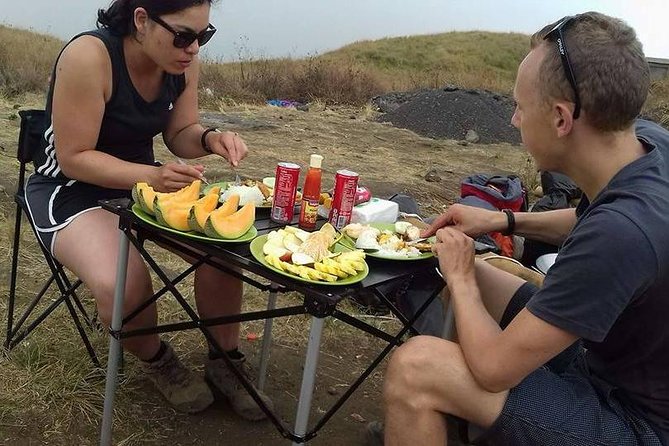
This is one of those hikes where the schedule is tight but the experience is not. You don’t just walk uphill and call it a day. You get a full Day 1 climb through tropical forest toward a high rim at 2,641 m, then a Day 2 morning with sunrise before descending back to Senaru village.
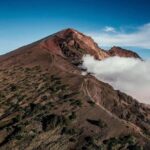
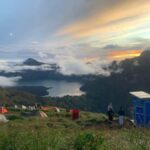
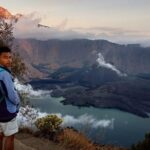
And the view promise is specific. You’re looking for a sunset over Mt. Agung in Bali, plus the drama of smoke from a nearby new volcano area seen from the lake. Even when weather softens the skyline, the sheer scale of Rinjani’s crater zone still hits hard.
There’s also a built-in “nature bonus” on the way down. If you’re lucky, you may spot a rare black monkey in the forest. That’s not guaranteed, but it’s exactly the sort of moment that makes a rim hike feel more alive than a stopwatch climb.
Day 1: From Senaru Village Into Thick Tropical Forest
The day starts early. You’ll have breakfast at your hotel around 6:30 a.m., then head to the Rinjani trek center in Senaru to register. The trek itself typically kicks off around 8:00 a.m. This matters because it sets your rhythm: you’re not rushing in the dark, but you’re also not starting when the day is already hot.
From there, the route goes through thick tropical forest, where the pace feels steady rather than frantic. You’ll get rest stops along the way, including:
- Pos 2 Montong Satas shelter (1,500 m)
- Pos 3 Mondokan Lolak (2,000 m)
After reaching Pos 3, you have lunch there and then continue on toward the rim.
Two practical things I like about this Day 1 structure:
- It breaks the climb into readable chunks, so you’re not constantly “all or nothing.”
- Lunch at Pos 3 gives you a clean energy reset before the final push to the crater rim.
At the top, you’re camping and setting up for the night. The included gear is designed for this specific setup: tents, sleeping mats, sleeping bags, and even camping chairs and a toilet-tent arrangement. That reduces the stress of figuring out logistics on arrival, which is half the battle on volcano treks.
You can also read our reviews of more tours and experiences in Lombok.


Sunset and the Rim Vibe: What You’re Actually Waiting For
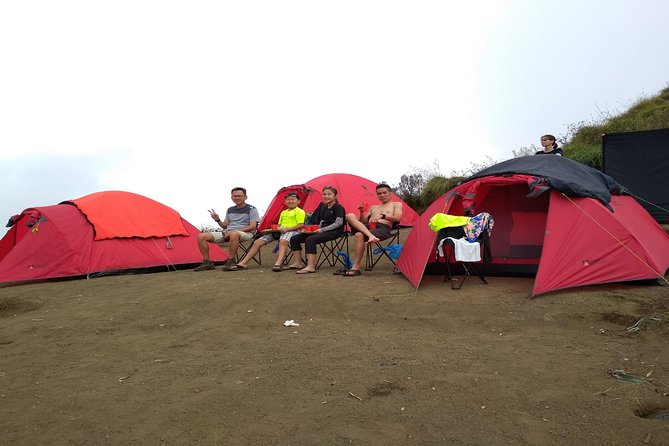
The big “moment” of Day 1 is not just reaching the rim. It’s what happens after—when the light shifts and Rinjani turns theatrical.
You’re aiming for:
- Sunset with a view toward Mt. Agung in Bali
- Possible visibility of volcanic smoke from the new volcano area by the lake
If you’ve ever climbed somewhere only to find the clouds flatlined the views, you’ll appreciate that this tour frames the rim experience clearly. You’re not hoping for random scenery. The timing and the plan are built around those visual cues.
Also, camping at altitude changes the feel. Nights near the crater rim tend to feel sharper than the forest below. You’ll want to be comfortable layering, and you’ll be glad you’re not carrying your whole sleep setup yourself.
Day 2: Sunrise, a Faster Rhythm, and a 5-Hour Descent
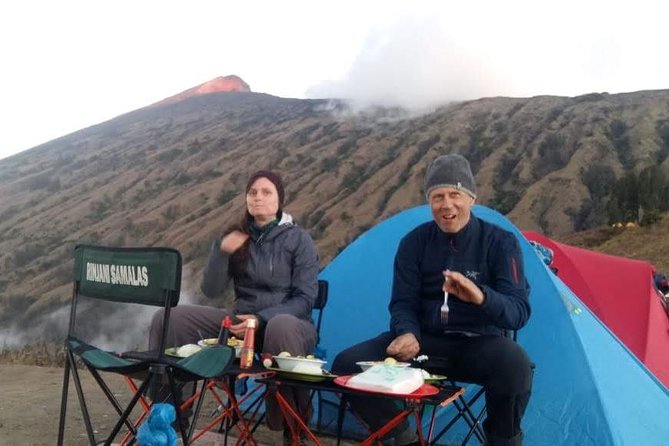
Day 2 starts with breakfast and a sunrise atmosphere. Then you begin the descent from Senaru crater rim (2,641 m) back down to Senaru village (601 m).
The downhill trek takes about 5 hours through the tropical forest. This is a major part of the experience people don’t always think about: descending is easier in effort but harder on your legs. Your knees and feet will feel it, even if the pace is manageable.
The forest also stays interesting on the way down. You might spot that rare black monkey again, depending on movement and luck. Even if you don’t, the mix of forest sounds and changing light is often the emotional payoff after a hard ascent.
Once you reach Senaru village, the program ends back at the meeting point. That keeps the whole thing from dragging into a third day of logistics, which is ideal if you’re trying to keep your Lombok trip tight.
Guides, Porters, and the Safety + Trash-Care Mindset
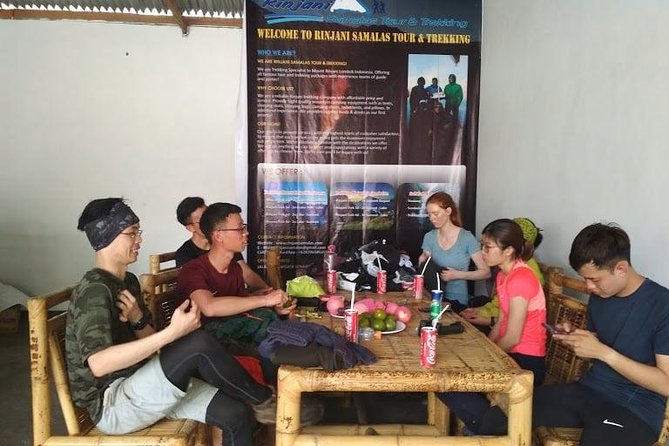
On Rinjani-style hikes, the best tour isn’t only about scenery. It’s about how the climb is managed.
This one comes with:
- An experienced English-speaking guide
- Professional porters
- A small-group cap of 20 travelers
The emphasis on safety and logistics shows up strongly in the feedback you can learn from. You’ll also notice a repeated point about care about trashes—meaning the team isn’t treating the mountain like a disposable playground. That’s not just a feel-good line. On a fragile ecosystem, it affects how the trek runs day to day: what you carry, how stops work, and how the group is handled.
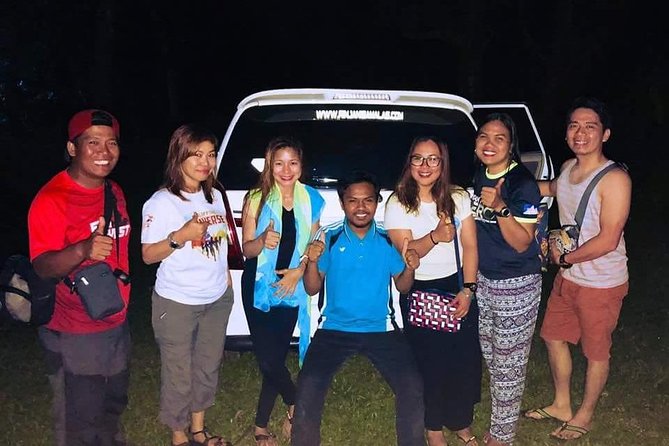
Names that come up in the experience stories include guides and porters like Nas, Sinthian, and porters Inas, Madi, and Kadir. People also mention staff support and kindness from helpers such as Azmi. While names won’t matter to the scenery, they matter to your day-to-day experience. When the team is organized, the hike feels calmer—even when it’s challenging.
Camp Setup and Trail Food: What’s Included Feels Practical
The included items are one of the clearest reasons this tour hits good value. You’re not only buying a guide and a route—you’re buying a complete on-mountain overnight kit.
Included camping equipment:
- Tents
- Sleeping mats
- Sleeping bags
- Camping chairs
- Toilet tents
- Pillow
Even if you’re an experienced hiker, hauling and setting up that stuff can drain your energy. Here, it’s handled for you, so your effort stays on the climb.
Food included is also a real deal:
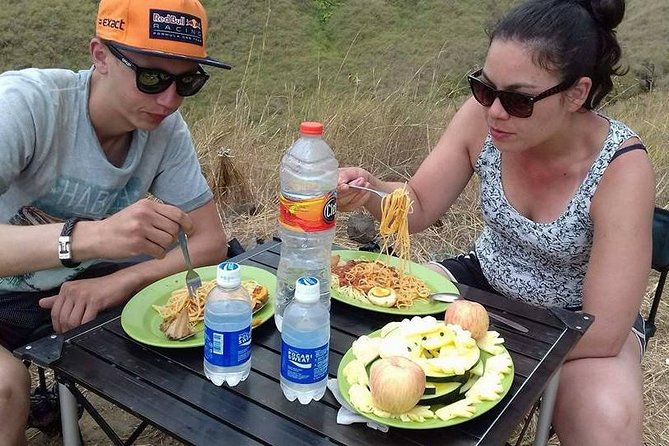
- All meals, snacks, fruits, and drinks on your trek
That matters because at altitude, energy management isn’t fancy. You just need consistent calories. The tour structure makes it easier to eat when you should, not when you happen to be passing a shop.
One more subtle point: when meals and camping basics are covered, you can pack lighter. And on a hike where you’re moving up to 2,641 m, lighter usually means less suffering.
Price and Value: Is $180 a Good Deal?
At $180 per person for roughly 2 days, this trek can feel like a lot on paper. But when you break it down, the price includes several expensive-to-organize elements:
- National park entrance fees
- A trained guide (English-speaking) and professional porters
- Full camping setup (not just a tent)
- All trail meals, snacks, fruits, and drinks
Then there are the things you don’t have to manage yourself: the trek center registration coordination, the gear logistics for night camp, and a group plan that keeps you moving between the specific points like Pos 2 and Pos 3.
What’s not included is important too. You’ll likely want to budget for:
- Tipping for your guide and porters
- An extra porter if you’re bringing lots of personal belongings beyond what you can carry comfortably
So here’s how I’d judge the value: if you want the classic Rinjani experience without turning it into a DIY logistics project, this price looks fair. If you already have gear, love planning every step, and you’re traveling with a helper to manage your load, then the value equation shifts. For most people, though, the included camp + meals are the difference between a fun trek and a stressful one.
Logistics You Should Plan Around (So the Trek Stays Fun)
A few practical details can shape how smooth your hike feels:
Start time discipline matters. Breakfast around 6:30 a.m., then trek begins around 8:00 a.m. If you’re late or rushed getting ready, you’ll feel it.
Weather is a factor. The experience is described as requiring good weather. If it’s canceled due to poor weather, you’ll be offered a different date or a full refund.
Group size stays controlled. With a maximum of 20 travelers, you’re not stuck with a mega-line at every break. That helps both comfort and timing.
You’re near public transportation. The meeting point is listed in Senaru, and it’s near public transportation, which can make it easier to fit into a broader Lombok plan.
Also, your meeting point is:
Rinjani Samalas Tour and Trekking, Jl. Pariwisata, Senaru, Kec. Bayan, Kabupaten Lombok Utara, Nusa Tenggara Bar. 83354, Indonesia
Since the tour ends back at the meeting point, it’s easy to plan your next move without a surprise second drop-off.
Who This Rinjani Samalas Crater Rim Hike Fits Best
This is described as moderate hiking with travelers asked to have a moderate fitness level. It’s also positioned as a good option for beginner trekker types because the schedule is short and the route is broken into stages.
I’d say it’s a strong fit if:
- You want a big Rinjani experience without committing to a longer multi-day trek
- You like structured pacing with rest stops and scheduled meals
- You want a team that handles camp gear and focuses on safety and waste care
It may be less ideal if:
- You have very limited hiking ability and you want a mostly flat experience
- You hate altitude climbs entirely (you go from 601 m up to 2,641 m)
- You’re expecting a walk you can treat casually. Even with “moderate” framing, it’s still a climb.
If you’re traveling as a family, the description says families with kids can opt for the package. The key is still that moderate fitness requirement. For families, this often means packing kids with the right energy and being realistic about pace.
Should You Book This Trek?
I’d book it if your goal is simple: see Rinjani’s crater rim in a short, well-managed format, with included camping comfort and enough food to keep you going. The strongest reasons are the combination of structured climb + sunset/rim timing + solid logistics + team support (and that repeat emphasis on safety and trash care).
I’d think twice only if you know you struggle with steep climbs or you’re traveling when weather is shaky and you can’t flex dates. Since the experience depends on conditions, having a little flexibility in your Lombok schedule makes the whole trip smoother.
If you’re ready to work for your views, this is a practical way to do Rinjani without turning your holiday into a gear-management project.
FAQ
How long is the Crater Rim Senaru trek?
The tour is listed as 2 days (approximately 2 days) with 1 night camping.
What route and altitudes are included?
You trek from Senaru village (601 m) to Senaru crater rim (2,641 m). Along the way there are rest stops at Pos 2 (1,500 m) and Pos 3 (2,000 m), then you descend back to Senaru village.
Is the hike suitable for beginners?
It’s described as moderate hiking and mentions it can work for beginner trekker types, as long as you have a moderate physical fitness level.
What’s included in the price?
Included are Mount Rinjani National Park entrance fees, camping equipment (tents, sleeping mats, sleeping bags, camping chair, toilet tents, pillow), an experienced English-speaking guide with professional porters, and all meals, snacks, fruits, and drinks on your trek.
What is not included?
Tipping for your guide and porter is not included. Extra porter service for personal belongings or other personal expenses is also not included.
Where does the tour start and end?
The start is at Rinjani Samalas Tour and Trekking in Senaru. The activity ends back at the meeting point.
Is the group large?
The tour has a maximum of 20 travelers.
What happens if weather is poor?
The experience requires good weather. If it’s canceled due to poor weather, you’ll be offered a different date or a full refund.